
Why not every “purple clay” is the same – and why seasoning makes all the difference
Yixing. A name that carries almost mythical weight among tea lovers. In this unassuming city in Jiangsu Province, something has been created for over 500 years that many consider the soul of Chinese tea culture: the unglazed Zisha teapot.
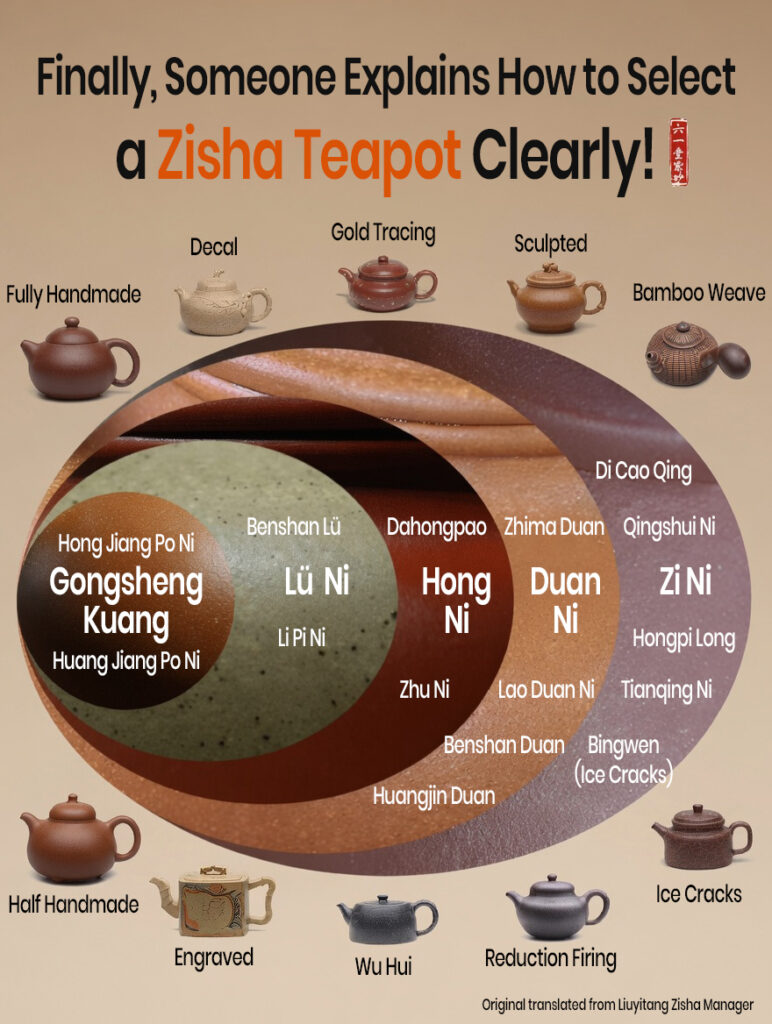
Yet behind the term “Zisha” (紫砂 – literally “purple sand”) lies far more than just a colour. It is an entire family of clays that differ significantly in structure, mineral content, density, porosity – and therefore in how they interact with tea. Those who understand these differences buy more consciously and, in the end, drink better tea.
The clay is found only in the Yixing area, primarily around Huanglongshan and Zhaozhuangshan mountains. It is rich in iron oxides, quartz and mica, and possesses a unique double porosity: tiny pores that allow air to pass while retaining liquid.
This property is exactly what makes Zisha so valuable for Gong Fu Cha:
Unlike porcelain or glass, a good Zisha teapot is not a neutral vessel. It actively interacts with the tea. That is why people say: a well-seasoned Zisha teapot improves with the years – while cheap imitations often remain dull and unchanged.
|
Main Group |
Chinese |
Typical Colours |
Surface Feel |
Effect on Tea |
Frequency / Price Level |
|
Zi Ni |
紫泥 |
Purple-brown, dark reddish-brown, grey-violet |
Classic, slightly sandy, warm |
Balanced, rounds out the tea, very versatile |
Very common / mid |
|
Hong Ni |
红泥 |
Red, orange-red, brick-red |
Slightly finer and warmer |
Livelier, a touch sweeter and warmer |
Common / mid |
|
Zhu Ni |
朱泥 |
Bright brick-red to orange-red |
Very fine, smooth, high shrinkage |
Clear, elegant, emphasises aroma and freshness |
Rarer / higher |
|
Duan Ni |
段泥 |
Beige, yellow, sandy, light grey |
Often speckled, more porous |
Brighter, fresher, slightly more open |
Common / mid |
|
Lü Ni |
绿泥 |
Greenish, beige-green |
Fine, calm |
Gentle, restrained, elegant |
Rare / higher |
Within these main groups there are many well-known variants and blends:
|
Main Category |
Sub-types |
Description |
|
Hong Ni |
Dahongpao (大红袍) |
A rich, dark-red Hong Ni variant |
|
Lü Ni |
Benshan Lü (本山绿) |
Light green to beige-green clay |
|
Zi Ni |
Tianqing Ni (天青泥) Qingshui Ni (清水泥) Di Cao Qing (底槽青) |
Cool, slightly bluish-grey tones Classic darker Zi Ni variants |
|
Duan Ni |
Huangjin Duan (黄金段) Lao Duan Ni (老段泥) Benshan Duan (本山段) Zhima Duan (芝麻段) |
Golden-yellow Duan Ni Various types of Duan Ni |
|
Gongsheng Kuang |
Jiangpo Ni (降坡泥) Hong Jiangpo Ni Huang Jiangpo Ni |
Reddish to yellowish-brown clays with good all-round properties |
Many modern teapots are carefully blended recipes rather than “pure” historical clays. This is not automatically a disadvantage. What matters is the quality of the raw material and the craftsmanship.
Colour alone says surprisingly little. Far more important are:
This is where one of the biggest differences between a new and a truly good Zisha teapot becomes apparent.
What does seasoning mean? Seasoning (often called “opening the pot” or simply “raising the pot” in Chinese) cleans and opens the pores of the teapot and allows it to slowly absorb the aromas of the tea. The pot “learns” the tea and later releases it subtly. At the same time the surface becomes smoother, warmer and develops a natural patina.
Why is it important? A brand-new Zisha teapot can initially taste a little earthy, dusty or even slightly metallic. Proper seasoning removes these unwanted notes and turns the teapot into a real partner for the tea.
A proven method for seasoning:
Important tips:
Those who take this process seriously will notice a clear difference after some time: the tea becomes rounder, softer and more harmonious, and the teapot itself feels more alive.
Zisha is not a status symbol. It is a tool that grows together with the tea and the person who uses it. Those who understand the clay types and take seasoning seriously will get significantly more out of their teas.
In the next article we will introduce the specific pieces we personally selected in Yixing – and explain why we chose exactly these clays and forms.
Until then: Pick up your own teapot. How does it feel? And most importantly – how does your tea taste in it after proper seasoning?
With the next infusion, Your MayTea team
–> Jun Kiln vs Chai Shao vs Yixing > Blog
Chat with us