
Among all Chinese ceramics, few are as legendary and visually captivating as Jun Kiln (钧窑). Famous for its dramatic “kiln change” (窑变), Jun porcelain seems almost alive — its glazes shifting in color and depth depending on light, angle, and time.
Jun Kiln is not just beautiful teaware. It is one of the highest expressions of Chinese ceramic art.
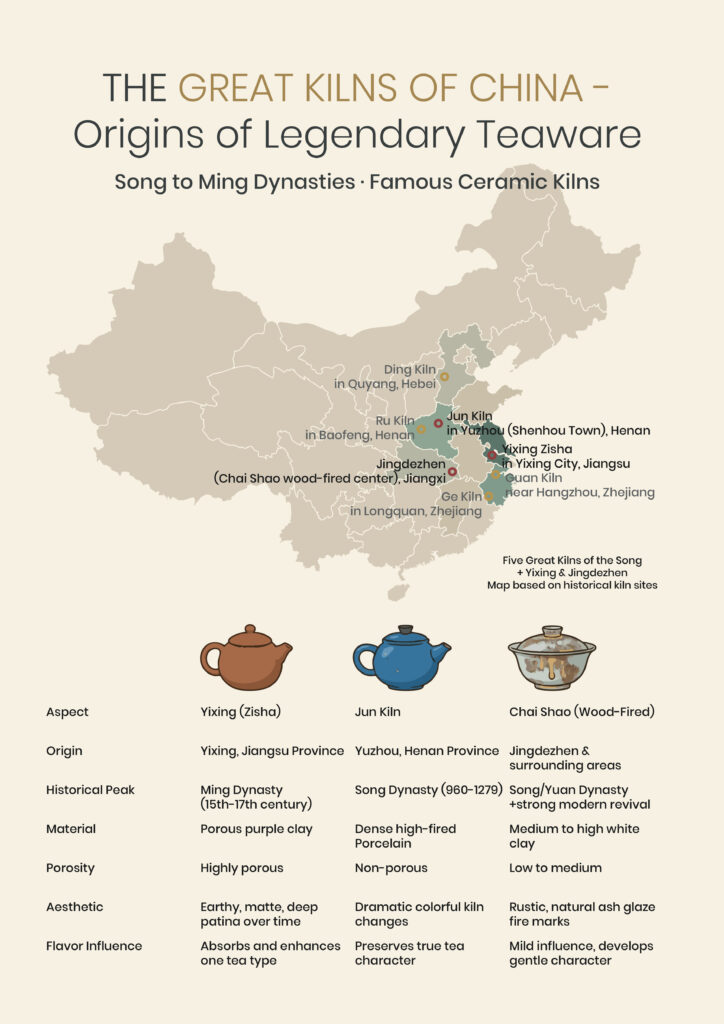
During the Song Dynasty (960–1279), Chinese ceramics reached their artistic peak. The emperors and scholars of this era celebrated five legendary kilns, known as the Five Great Kilns (五大名窑):
While the other four kilns are admired for their refinement and elegance, Jun Kiln stands out for its bold, expressive beauty and its almost magical transformation in the kiln.
What makes Jun porcelain so special is the 窑变 (Yáo Biàn) — the kiln transformation. During the high-temperature firing (often above 1300°C), copper and iron oxides in the glaze react unpredictably with the atmosphere inside the kiln. This creates flowing rivers of color — deep reds, purples, blues, turquoise, and even milky whites — that no artist can fully control.
Each piece is truly one-of-a-kind. Even pots fired together in the same kiln can look completely different.
In modern times, Master Wen Hongyuan from Yuzhou, Henan Province (the historical home of Jun Kiln) has become one of the leading figures reviving and elevating this ancient art. His works are highly sought after by collectors, and several of his pieces are now part of the National Museum of China collection.
Unlike highly porous Yixing clay, Jun Kiln porcelain is dense and non-porous. This means:
Best suited for:
It is less ideal for heavily fermented Shou Pu-erh or very dark aged teas.
Jun porcelain is relatively easy to maintain:
Jun Kiln teapots are more than functional vessels — they are miniature works of art born from fire and mystery. In a world full of mass-produced objects, they remind us that true beauty often lies in the unpredictable, the imperfect, and the deeply human connection between earth, fire, and time.
To hold a Jun Kiln teapot is to hold a small piece of Song Dynasty poetry in your hands.
–> Jun Kiln vs Chai Shao vs Yixing > Blog
–> Yixing > Blog
Chat with us
We noticed you're visiting from Germany. We've updated our prices to Euro for your shopping convenience. Use United States (US) dollar instead. Dismiss